The Identity
The book THE IDENTITY is about becoming a Documentary Film Director
In early 2026, Mikael Opstrup invited 11 documentary directors from 11 countries to reflect on their profession: how they see themselves as directors, how the process of becoming one unfolded, and what the work means to them. The result is THE IDENTITY.
Inside you will find:
- Reasons for not calling oneself a director
- Childhood memories that seem important today
- The blessing of self-imposed obstacles
- Regrets of choosing this profession
- How drawings can replace words
- Am I still a director if I don’t direct for a longer period?
- And so much more
Each chapter has two parts: the director’s own text, and a conversation with Mikael Opstrup, the initiator of the book.
A book for everyone engaged in documentary filmmaking – and for documentary enthusiasts in general.
Chapters of the book
Click
to read excerpt
From the text:
Each time I start a new film, I long for the innocence of the first time I picked up the camera. I wish to shake off all the experience and discover in the act of making, be surprised and thrilled, unleash the very first sensations of creating.
From the talk:
My visual language comes from my individual sensibility, but also from my own limitations. For example, I am bad with handheld camera, and I am not a dynamic person that moves around in a situation. I don’t feel comfortable getting too close to people and I prefer to observe from afar, from a corner. […] Ultimately, my personal character is translated into my film language.
From the text:
Director is an interesting word. It’s not a word I’ve ever identified with personally. It’s a grand word for a process which isn’t so grand. […] If asked what I do, I never call myself a director. I might reply that I make documentaries – or try to. Or try not to. Or maybe they make me.
From the talk:
I’ve learned to trust those things that don’t quite go away. The very reason for not wanting to get involved is often the reason why it would make such a good story.
But there have been projects I have backed away from because I’ve felt that I can’t allow my life to be taken over to quite that extent.
From the text:
What remains is the process: walking, looking, listening, entering, being surprised, being wrong, changing my mind, staying with something long enough to let it contradict me, finding a form, and letting it go.
Perhaps that is as close as I come to an identity – not a fixed self, but a way of moving through the world. After all these years, I am still becoming.
From the talk:
If you’re simply observing a situation, you can be a fly on the wall. But as soon as you bring a camera into a scene, you change it. That’s why I use the term ‘embedded flâneur’, and why I make sure the viewer understands that what they are seeing is a creative interpretation of actuality.
From the text:
Documentary is not a genre. It’s a method. And the method is the documentary process. The documentary process involves a relationship with the subject before, during, and after the recording.
From the talk:
I have a lot of beautiful images, but the images of my friends and family were beautiful because I love them. And it was obvious that no one else could take that photo. Nobody. That made it interesting and exclusive. I still believe that all films must be filmed from within a community to be interesting to me.
From the text:
And while everyone does it differently, maybe that’s what a director ultimately is? A kind of shapeshifter… […] But whatever the task, I’ve never met a director who wasn’t willing to do whatever it takes or become whoever they need to be, to make the best film possible.
From the talk:
In some of my personal films, I’m the fish, the fisherman and the chef. Another way of saying it is that I’m the subject of what’s being explored, the person doing the exploring, and the person who must draw conclusions about this exploration. […] I want every film I make to be both a window and a mirror.
From the text:
So when you ask me to write about becoming, I find myself suspicious of the verb. Becoming suggests a road with a direction. Mine has felt more like a circling. Sometimes a disappearance. Sometimes a return. I have been a director the whole time, and I have not been a director the whole time. Both are true.
From the talk:
Maybe it’s an identity, but I really see it as a position. I call it a posture because it’s how you hold yourself in a place. I see and hear stuff, you know, and then something in me becomes restless and I want to make a film about it. […] It feels more like standing in a place where you cannot turn around and pretend you don’t see or hear. It’s like beyond you. And what you do with that is filmmaking.
From the text:
Doubt can be paralysing, but not having any doubt is frightening. For how can you listen then? Doubt is an open door. Doubt is a vessel that carries you from coast to coast. […] I believe that art is shaped, amongst other things, by doubt.
From the talk:
I talked to some actors during Corona times, where they could not work. They wondered: Am I an actor if I’m not acting? So, am I a film director, when I’m not directing? And what are my frustrations and reasons to give up directing for now? Can I look at that, or am I too afraid of shaking the boat with the only thing I am really good at?
From the text:
Today, I see myself as a builder of bridges between the intimate and the collective. My films connect Niger to the rest of the world, but they also connect my personal story to that of thousands of other women and men.
For me, documentary filmmaking means transforming pain into light: a mission that can wound, but which always opens paths towards dignity.
From the talk:
At six, I was searching for my father’s gaze. Today, with my camera, I seek to look at those whom society does not always want to see. […] My father said to me: “I saw you.” Perhaps my cinema is, in its own way, an attempt to tell others: I see you. Your story deserves to exist.
From the text:
Directing has taught me two essential truths: the world is sacred, and the world holds a mystery that can only be expressed through the language of cinema. […]
I believe that the secret of documentary filmmaking lies in the ability to be astonished. Everything else – the aesthetics of the frame, the dramaturgy of storytelling, the dynamics of editing – can be learned.
From the talk:
Astonishment is sensitivity to the world; to be surprised and to see things as if you see them for the first time. It is a little bit childish, but without that you cannot be in this profession. […] You pick up a stone, and if you’re not surprised by this stone, you have nothing to do in this profession.
From the text:
When I studied filmmaking, I was taught a model in which the director was a kind of God who controlled everything. But life does not work that way, and documentaries even less so. […] Documentary filmmakers are more like sculptors. We have an enormous rock, which is reality, and we must remove and remove stimuli and information until a figure emerges.
From the talk:
I always have a subject, a character, a story. But for me this is not a film. […] You only know that it’s a film when you discover the right visual form for a certain topic.
From the text:
In moments when I once again realise how difficult this profession is, I return to the past and regret that I chose this particular profession, in this particular country, and, it seems, at the wrong time. I am not one of those who enjoy life, but I am one of those who find life interesting.
From the talk:
Documentary filmmaking lets you see the world through other people’s eyes, through their lenses. It lets you live more than just your own life. You begin to understand that things are not simply black and white; there are so many shades.
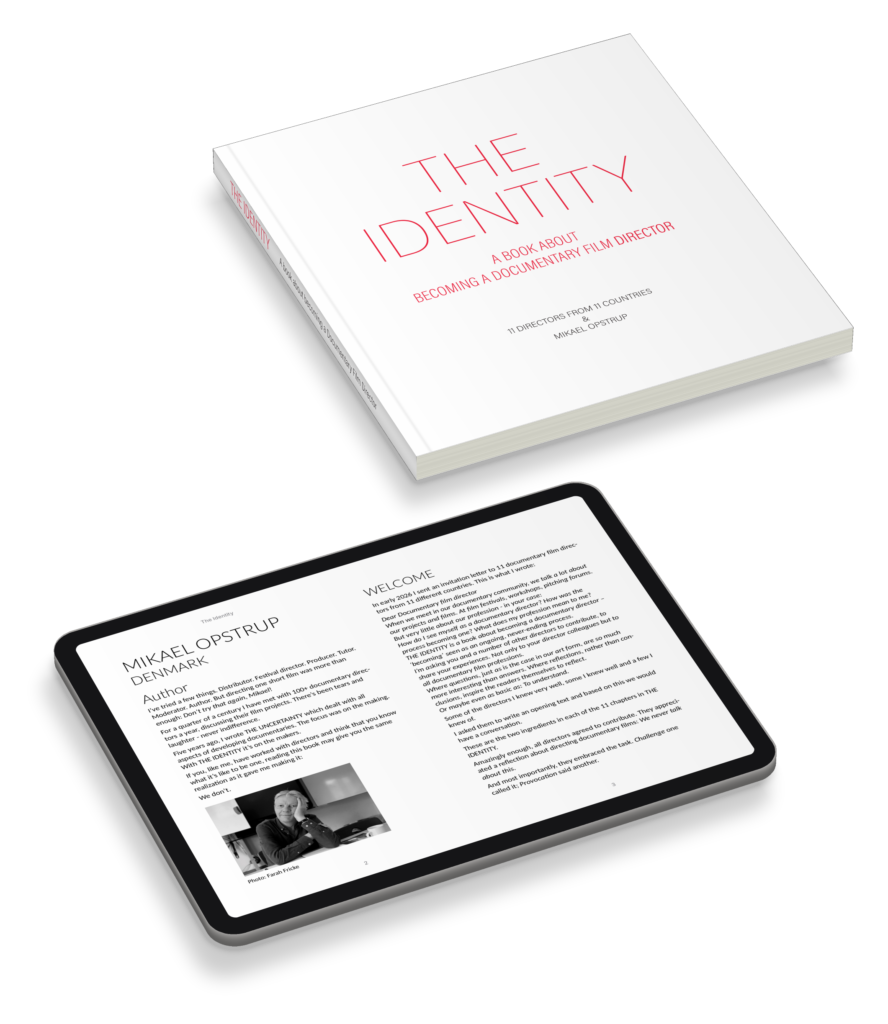
Get the book
“Before I started the meetings with these 11 directors I thought I knew quite a bit about what it is like to be a documentary director. Now I know I didn’t.”
– Mikael Opstrup
Hard copy
Printed edition | 140 pages | Ships worldwide | 1st edition 2026
E-book
Apple Books, Kindle and Google Play | Instant download | No shipping costs